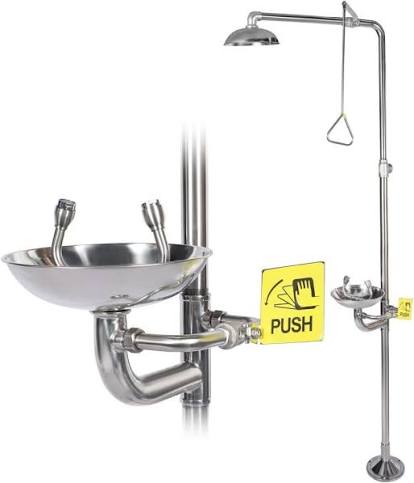
Specifying safety showers and eyewash in Saudi Arabia
How to specify emergency showers and eyewash to ANSI/ISEA Z358.1 in Saudi Arabia, and why tepid water is the requirement that gets engineered last.
The numbers first, because they are what a specification has to hit.
| Requirement | Emergency shower | Eyewash |
|---|---|---|
| Flushing fluid flow | 75.7 litres per minute minimum | 1.5 litres per minute to both eyes |
| Duration | 15 minutes minimum | 15 minutes minimum |
| Fluid temperature | Tepid, 16 to 38 °C | Tepid, 16 to 38 °C |
| Activation | Stays on hands-free once activated | Stays on hands-free once activated |
| Accessibility | Reachable in about 10 seconds, on the same level, unobstructed | Same |
Those come from ANSI/ISEA Z358.1, which is the standard most projects in the Kingdom are specified against. The European series, EN 15154, splits by setting instead — and that split is the first thing worth knowing, because it is routinely got wrong.
If you are quoting EN 15154, quote the right part
EN 15154 has six parts, and the ones vendors most often cite are the laboratory ones:
| Part | Covers |
|---|---|
| 15154-1 | Plumbed-in body showers for laboratories |
| 15154-2 | Plumbed-in eyewash units |
| 15154-3 | Non-plumbed body showers |
| 15154-4 | Non-plumbed eyewash units |
| 15154-5 | Water overhead body showers for sites other than laboratories |
| 15154-6 | Plumbed-in multiple nozzle body showers for sites other than laboratories |
A process plant, a tank farm or a workshop is not a laboratory. Parts 5 and 6 are the ones that apply, and a quotation citing part 1 for a refinery is citing the wrong document — usually because the vendor's literature was written for a European laboratory market.
The requirement that gets engineered last
Everything above is straightforward except one line, and that line is where installations in this region fail: tepid water, 16 to 38 °C, for fifteen minutes.
Consider what actually feeds a shower on a plant in July. A galvanised line runs across an open yard, above ground, in full sun. The water standing in it has been there since the last weekly test. When somebody hits the pull rod, what comes out first is not tepid — it is hot enough that a casualty steps out of the stream, and stepping out of the stream is precisely the failure the fifteen-minute requirement exists to prevent. Nobody flushes a chemical burn for fifteen minutes in water that hurts.
The requirement is therefore an engineering problem to be solved at design, not a box to be ticked at handover. The options, roughly in order of cost:
- Move the pipework. Route it underground, in shade, or inside the building. The cheapest fix, and only available before the trenches close.
- Insulate and jacket the run. Helps with the standing water, does nothing about the supply temperature if the whole system is warm.
- Circulate. A recirculating loop keeps the water moving so nothing stands and cooks in a dead leg.
- Temper actively. A tempering valve blending from a cooled source, or a self-contained tank unit with active cooling where there is no cold supply to blend from.
Which one is right depends on the site, but the decision has to be made by somebody, and the enquiry should say what the measured line temperature is rather than assuming the mains will provide.
The other five things buyers leave out
1. Is there actually 75.7 litres per minute available? A shower is a large draw. On a long run, a small bore, or a system with several units that could be called on at once, the flow at the head is not the flow at the main. Somebody should calculate it, and the enquiry should state the available flow and pressure.
2. Where does the water go? Fifteen minutes at 75.7 litres per minute is over 1,100 litres on the floor. Indoors that needs a drain or a sump; outdoors it needs somewhere that is not the foundation of the equipment next to it. If the casualty was covered in a process chemical, the water is now contaminated and containment may be required.
3. Can somebody reach it in ten seconds? The standard expects the equipment to be accessible within about ten seconds of the hazard, on the same level and without an obstruction in the way. Ten seconds is not far when the casualty cannot see. Walk the route with a stopwatch, with your eyes shut and somebody guiding you, and the position usually chooses itself. A door counts as an obstruction. So does a step.
4. What comes out of the nozzles first? A branch used only during the weekly test accumulates sediment and stagnant water. Dust caps that clear on activation keep the nozzles clean between uses, and they are not an accessory. The weekly activation itself is what keeps the branch flushed, which is another reason the drainage question matters — a unit nobody can test without flooding something will not be tested.
5. Where does no plumbing exist? Temporary work fronts, tank farms during a shutdown, remote sites and vehicles need self-contained units. Those have their own decision: plain water with a preservative and a documented change interval, or sealed cartridges with an expiry date and no changing. In this climate add a third consideration — a tank standing in direct sun reaches temperatures that make the contents useless and shorten the life of whatever is in them, so the mounting position and a shade or insulated cover belong in the specification.
Commissioning and keeping it working
Equipment that is installed and never tested is equipment that will not work. Three habits cover most of it:
- Weekly activation of every plumbed unit, run long enough to clear the branch, with the result recorded.
- An annual full performance test against the flow, pattern and duration the standard requires — not a glance at the valve.
- Temperature measured at the head, in summer, at the worst hour of the day, because a tempering arrangement that works in February proves nothing.
A specification checklist
Send this with the enquiry and the offer will be comparable:
| Item | State |
|---|---|
| Standard | ANSI/ISEA Z358.1, or the correct EN 15154 part |
| Unit type | Shower, eyewash, eye/face wash, or combination |
| Supply | Plumbed, gravity tank, or self-contained |
| Available flow and pressure | Measured at the position, not at the main |
| Line temperature | The real figure at the worst hour |
| Tepid water method | Tempering, insulation, recirculation, or cooling |
| Drainage | Where 1,100 litres goes, and whether it needs containment |
| Position | Travel time from each hazard, and what is in the way |
| Hazardous area | Zone, if any electrical accessory is fitted |
| Alarm | Flow switch, beacon, sounder, or a BMS signal |
| Materials | Corrosion exposure at the position |
| Testing access | How the weekly activation will be run off |
NIFAL (MNT) supplies emergency showers, eyewash and eye/face wash units from Dammam, including tempered and self-contained arrangements for sites with no cold supply. Send the measured line temperature with the enquiry and the tepid water question gets answered in the offer rather than at commissioning.